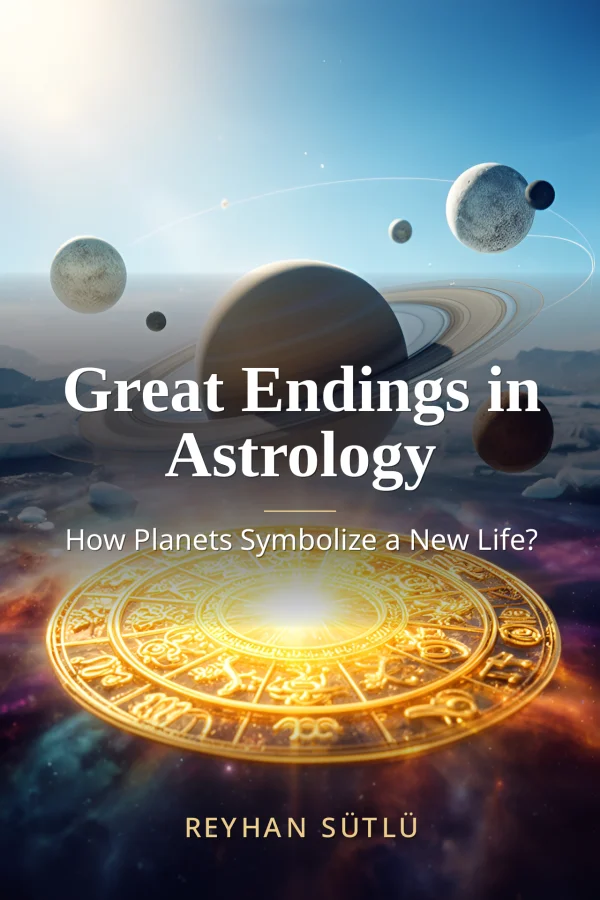
Great Endings in Astrology: How Planets Symbolize a New Life?
Reyhan SÜTLÜ
- Category Astrology
- Format PDF
- Size 3.9 MB
- Added 18.04.2025
- Views 313
Great Endings in Astrology explores how planetary placements and cycles can be read as markers of closure, transition, and renewal. Reyhan Sütlü approaches astrology not as fortune-telling but as a symbolic language, showing how the end of one chapter in life—a relationship, a career, a way of understanding oneself—can be reflected in the movements and positions of the planets. The book examines what it means for an ending to be "great": not merely an ending that is painless, but one that clears space for something genuinely new.
The reader is guided through the symbolic logic that connects planetary archetypes to the experience of letting go and starting again. Rather than offering fixed predictions, the author encourages a reflective reading of charts and transits, treating them as prompts for self-inquiry. Themes such as Saturn's lessons in release, the cycles of the outer planets, and the role of the natal chart in shaping how a person meets change are woven together with an emphasis on personal agency and interpretation.
This book is intended for readers who already have a basic familiarity with astrological vocabulary and want to deepen their practice, as well as for anyone drawn to the symbolic study of life transitions. It suits those interested in using astrology as a tool for reflection during periods of change, and it invites readers to consider how endings, however difficult, can be understood as part of a larger pattern of renewal.
Read the Book
If the PDF does not appear, open it in a new tab.
Table of Contents
- Chapter 1 — What Is an Ending, and What Does Astrology Say? 3p. 3
- CHAPTER 1p. 5
- CHAPTER 2p. 10
- CHAPTER 3p. 17
- CHAPTER 4p. 22
- CHAPTER 5p. 27
- CHAPTER 6p. 31
- CHAPTER 7p. 37
- CHAPTER 8p. 42
- CHAPTER 9p. 48
- CHAPTER 10p. 53
- CHAPTER 11p. 58
- CHAPTER 12p. 62
A Chapter from the Book: Chapter 1 — What Is an Ending, and What Does Astrology Say? 3
CHAPTER 1 What Is an Ending, and What Does Astrology Say? An ending rarely announces itself as an ending. It usually arrives disguised as an ordinary Tuesday: a resignation email you keep rewriting, a box you haven't unpacked yet, a phone call you've been putting off. On the outside life looks the same. Inside, something has already shifted, and you can feel it before you can name it. This book is about that feeling — and about what astrology has to say about it. Not as a crystal ball, not as a verdict, but as a language for recognizing cycles that were already moving through your life. Endings are not the opposite of a good life. They are part of its structure. The Endings We Don't Call Endings When people hear the word ending, they usually think of something dramatic: a breakup, a loss, a door slamming. But most endings are quieter than that. Leaving a job you've outgrown. Moving cities and realizing the old one no longer fits. Letting a long friendship fade because you both changed and neither of you said so. Changing a daily routine you've followed for years, almost without noticing. These are ordinary events, but they carry a strange weight. A part of you knows something is finishing. Another part keeps negotiating: maybe it's not so bad, maybe I should wait, maybe this is just a rough patch. That inner tug-of-war is normal. It's what endings feel like from the inside, before anyone has given them a name. Here's the plain-language version: an ending is any point where a familiar pattern of your life stops being workable. It can be a role, a place, a relationship, or a habit. What makes it an ending isn't the size of the change. It's that something you relied on no longer holds. What This Book Is — and What It Isn't This book looks at how astrology interprets closing and rebuilding themes. It examines progressed Moon cycles, planets changing signs and houses, Saturn's angles, and the symbolic meanings the tradition attaches to certain periods. The goal is not prediction. It's perspective — a way to look at a transition and see structure in it rather than chaos. It's worth being very clear about what this is not. It is not a promise that the sky will fix anything, and it is not a claim that any planet causes an event in your life. Astrology, at its best, is a symbolic language. It offers images and cycles you can think with. What you do with them is yours.
It also won't hand you a script. You won't find guarantees in these pages, or a method that changes everything overnight. What you will find is a way of looking at endings that makes them a little less frightening and a little more workable — one small, sustainable step at a time. How the Tradition Explains It In the astrological tradition it is held that the sky moves in cycles, and that human life moves in cycles too — and that the two can be read side by side, symbolically. This is a claim about meaning, not about mechanics. Nobody is saying a planet reaches down and rearranges your life. The tradition's own inner logic is different: it treats time as patterned, and it uses the positions of celestial bodies as markers for those patterns. The key word there is cycles. Astrology is far less interested in single events than in rhythms — beginnings, middles, and yes, endings. Where a modern reader might ask "what will happen," the tradition tends to ask "what phase is this?" That shift in question changes everything about how you read a difficult period. The Vocabulary You'll Keep Meeting As you read on, a handful of terms will keep coming back, so it helps to meet them early. The progressed Moon refers to a symbolic way of tracking the Moon's movement over the course of a life, used in the tradition to mark emotional seasons — chapters of inner life that open and close. Planets changing signs or houses are read as shifts in emphasis: a theme that was loud becomes quiet, or one that was in the background steps forward. Then there's Saturn, which the tradition associates with limits, time, and maturity — often described as the planet of "enough is enough." And there are angles: relationships between points in a chart that the tradition reads as moments of tension or turning. You don't need to memorize any of this now. You'll see each one return, always in the same symbolic role, and familiarity will build on its own. One more piece of vocabulary matters more than the rest: the idea that a chart describes potential and timing, never obligation. In the tradition it is held that certain periods favor closure and others favor building. What that means in practice is something you decide, in your own life, with your own judgment. The sky offers the weather report. You still choose whether to go outside. How It's Practised, Step by Step
You don't need a professional astrologer or expensive software to begin. You need three things: your birth date, your birth time (as precise as you can find it), and your birth place. From those, a chart can be calculated — many free tools online will do it — and from that chart, the cycles this book talks about can be traced. That's the whole setup. Everything else is reading and reflection. Step one: get your chart, and get the birth time right.
This section is a preview taken from the book (about 928 words). To continue, read the book or download the PDF.
Book Details
- Book
- Great Endings in Astrology: How Planets Symbolize a New Life?
- Author
- Reyhan SÜTLÜ
- Category
- Astrology
- Language
- English
- Format
- PDF · 3.9 MB
- Pages
- 66
- Words
- about 25,500
- Chapters
- 13
- Published
- Reyhan SÜTLÜ · 18.04.2025
- Access
- Free to read and download; for personal use only, all rights belong to the author.
Frequently Asked Questions
Is the PDF of Great Endings in Astrology: How Planets Symbolize a New Life? free?
Yes. Great Endings in Astrology: How Planets Symbolize a New Life? can be read and downloaded for free on this site; no sign-up or payment is required.
How many pages is Great Endings in Astrology: How Planets Symbolize a New Life??
Great Endings in Astrology: How Planets Symbolize a New Life? has 66 pages and about 25,500 words.
Which devices can I read Great Endings in Astrology: How Planets Symbolize a New Life? on?
It is a PDF; you can read it in your browser on a phone, tablet or computer, or download it and open it offline.
Who is the author of Great Endings in Astrology: How Planets Symbolize a New Life??
Great Endings in Astrology: How Planets Symbolize a New Life? was written by Reyhan SÜTLÜ; it is listed in the Astrology category.
Similar Books
 Love or Habit? The Secrets of Venus and the Moon Sign
Reyhan SÜTLÜ
 Why Do You Always Choose the Wrong Person in Love?
Reyhan SÜTLÜ
 Late Marriage in Astrology: The Secrets of Saturn and the Seventh House
Reyhan SÜTLÜ
 The Astrological Chart of Your New Year: What Will the Coming Year Bring You?
Reyhan SÜTLÜ
 Destiny Years in Astrology: Which Is the Most Important Period of Your Life?
Reyhan SÜTLÜ
 Skin Harmony in Astrology: The Hidden Attraction Between Venus and Mars
Reyhan SÜTLÜ